
By Omana Projects ·
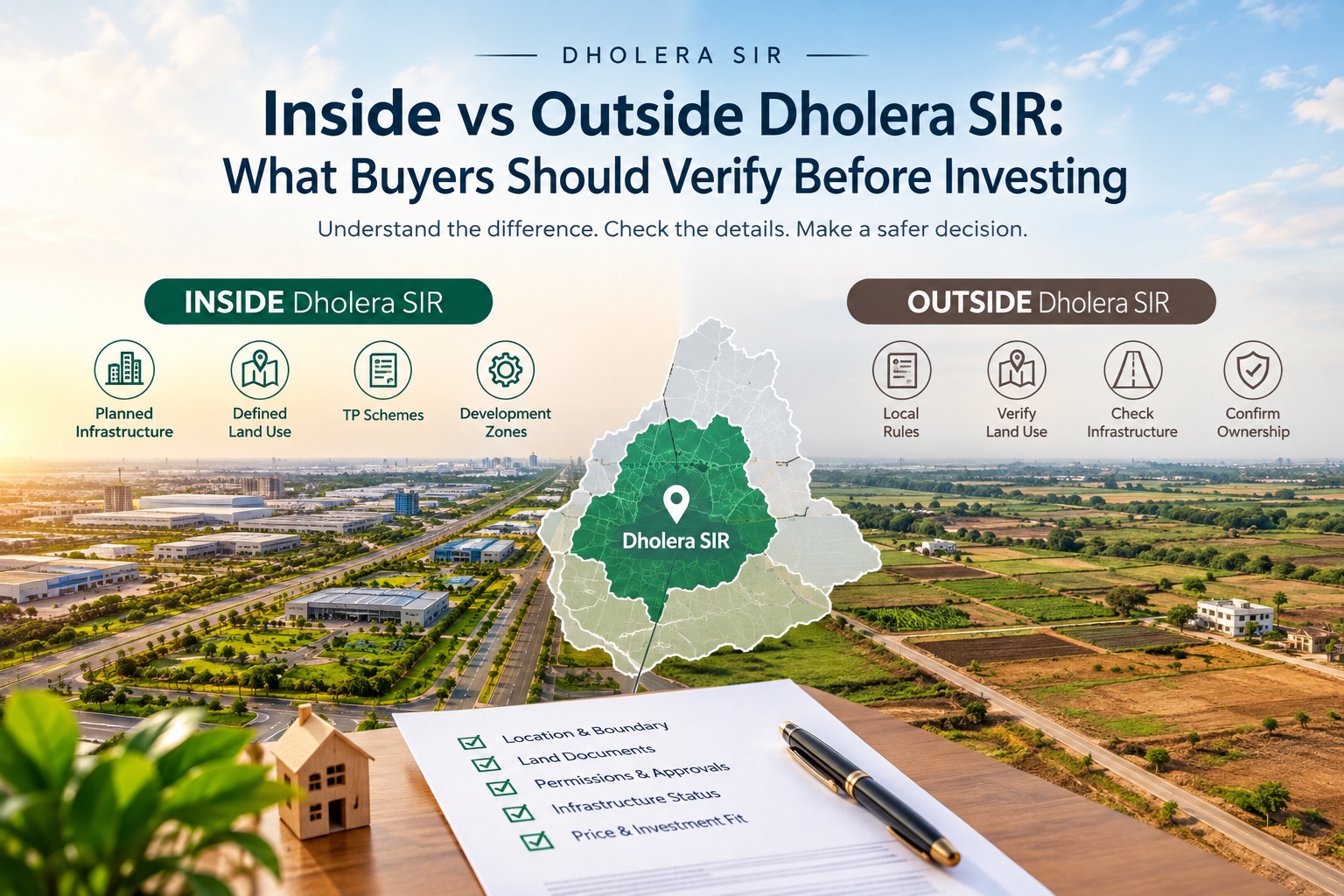
Dholera has attracted attention from residential plot buyers, land investors and businesses because of its planned industrial development, transport connectivity and proposed urban infrastructure. However, one important question is often overlooked during a property search: Is the plot actually inside the notified Dholera Special Investment Region (SIR), or is it located outside the boundary but marketed as being near Dholera?
The distinction matters because a project's name, distance from Dholera, promotional map or sales brochure does not establish its legal location. Land inside the notified SIR and land in nearby villages outside the boundary can have different planning frameworks, development conditions and infrastructure arrangements.
Neither location should be judged by price alone. The right decision depends on the exact property, its legal status, applicable permissions, road access, intended use, budget and investment horizon.
This guide explains the difference between plots inside and outside Dholera SIR and provides a practical checklist to help buyers verify a property before paying a booking amount.
What Is Dholera SIR?
Dholera Special Investment Region is a planned industrial city and development region in Gujarat. Its development framework includes industrial, residential, commercial, logistics, public-facility and other land-use categories.
The region is associated with the Gujarat Special Investment Region Act and a dedicated planning and development framework. The official Dholera development brochure describes a planned area of approximately 920 square kilometres, with development organised through designated zones and infrastructure planning.
However, the entire planned region should not be confused with the Activation Area, which is a smaller area being developed in phases. Nor does every property advertised as a Dholera plot necessarily fall inside the notified SIR boundary.
For background on the region, buyers can read the Dholera SIR development and project overview on Omana Projects.
What Does It Mean to Buy a Plot Inside Dholera SIR?
A plot inside the notified SIR boundary falls within the relevant regional planning jurisdiction. Depending on its location, it may also be affected by an applicable Town Planning (TP) scheme, designated land use, road reservations and other development provisions.
Buyers should understand that being inside the SIR does not automatically mean that every plot is ready for construction, has all permissions or is eligible for every intended use. The specific plot and its applicable planning status must still be checked.
Before purchasing a plot inside the SIR, verify the following:
- Exact location: Confirm the village and survey number against the relevant official records.
- Town Planning scheme: Determine whether the land falls within a relevant TP scheme and whether the applicable plot is an Original Plot (OP), Final Plot (FP) or another recorded parcel.
- Permitted land use: Check whether the proposed residential, commercial or other use is permitted for that parcel.
- Development status: Establish which roads, utilities and other facilities are operational, under construction or planned.
- Ownership and title: Review ownership records, encumbrances and the legal authority of the seller to transfer the property.
- Construction conditions: Confirm applicable building permissions and other requirements before assuming that construction can begin.
The SIR designation is an important part of due diligence, but it is not a substitute for property-specific legal verification.
What Does It Mean to Buy a Plot Outside Dholera SIR?
A plot outside the notified SIR boundary may be located in a nearby village or along a corridor associated with the wider Dholera development region. Such a property may be marketed as a plot near Dholera SIR, near the expressway or within reach of planned infrastructure.
Outside the boundary does not automatically mean that a property is unsuitable or legally invalid. Equally, proximity to Dholera does not give the property the same planning status as land inside the notified SIR.
The applicable revenue records, land-use rules, local authority permissions and development conditions must be assessed for the actual parcel.
For a property outside the SIR, buyers should pay particular attention to:
- Land ownership: Confirm the seller's title and the chain of ownership.
- Survey number and boundaries: Match the revenue records to the physical site and the plot shown on the layout.
- Non-Agricultural (NA) status: Check whether the required land-use permission applies and obtain the relevant documentation where applicable.
- Layout approval: Verify the applicable approval status of the layout and the plot being offered.
- Legal road access: Establish whether access is legally recorded and physically usable, rather than relying only on a brochure.
- Local development rules: Identify the authority responsible for the land and the permissions applicable to the proposed use.
- Infrastructure claims: Verify the actual status of water, electricity, drainage, roads and other services.
Buyers considering locations outside the SIR can also read the Kasindra plot documents, sizes and SIR boundary guide for additional examples of the checks involved in evaluating a nearby residential plot.
Inside vs Outside Dholera SIR: Key Differences
1. Planning Framework
- Inside SIR: Relevant SIR planning and development framework applies.
- Outside SIR: Applicable local and state planning and land rules must be identified.
2. Town Planning Schemes
- Inside SIR: A relevant Town Planning (TP) scheme may apply, depending on the parcel.
- Outside SIR: Do not assume that an SIR TP scheme applies.
3. Land Use
- Inside SIR: Verify the designated land use and applicable restrictions.
- Outside SIR: Verify the relevant local land-use permissions.
4. Infrastructure
- Inside SIR: Check the actual infrastructure and development status for the specific location.
- Outside SIR: Confirm which infrastructure is available and which facilities are only planned.
5. Documentation
- Inside SIR: Verify title, survey details, applicable TP/Final Plot (FP) records and permissions.
- Outside SIR: Verify title, survey details, NA status where applicable, layout and local permissions.
6. Price
- Inside SIR: Pricing depends on location, plot size, status, access and other factors.
- Outside SIR: Pricing also depends on location, plot size, status, access and other factors.
7. Construction
- Inside SIR: Construction is subject to applicable permissions and conditions.
- Outside SIR: Construction is also subject to applicable permissions and conditions.
8. Investment Risk
- Inside SIR: Risk depends on the specific plot, documentation and transaction.
- Outside SIR: Risk likewise depends on the specific plot, documentation and transaction.
Why the Exact SIR Boundary Matters
One common source of confusion is the use of broad location descriptions such as “Dholera plots,” “near Dholera SIR” or “Dholera Smart City plots.” These phrases can describe a marketing area rather than a property's precise legal location.
A village name alone may not always be enough to determine the status of an individual parcel. In some locations, different portions of land may have different relationships to a notified boundary or planning scheme.
For that reason, buyers should avoid making a decision solely on the basis of a Google Maps pin, a distance claim or a salesperson's verbal assurance.
The more reliable approach is to establish the property's revenue village, survey number and exact location, then compare those details with the applicable official notification, planning map and land records.
A site visit is useful, but it cannot independently establish the legal SIR status of the land. Similarly, a map screenshot can help locate the property but should not replace official records.
How to Verify Whether a Plot Is Inside or Outside Dholera SIR
Follow these steps before paying a booking amount or signing an agreement.
1. Obtain the Exact Survey Number
Ask the seller for the revenue village, survey number, plot number and a site plan that identifies the land being sold. Make sure these details are consistent across the documents.
If the seller provides only a project name or a broad location, request the missing information before proceeding.
2. Check the Notified Boundary
Compare the survey details with the relevant official SIR notification and planning maps. Where the boundary or scheme status is unclear, obtain confirmation from the competent authority or a qualified local property lawyer.
Do not treat proximity to the boundary as proof that the plot lies inside it.
3. Verify the TP Scheme and Plot Status
For land represented as being inside a TP scheme, ask for the relevant scheme information and the records identifying the applicable Original Plot or Final Plot, where relevant.
Check whether the plot number used in the sales material corresponds to the official records. A project layout number should not automatically be treated as a government-issued Final Plot number.
4. Review Ownership and Encumbrances
Ask for current ownership and revenue records, the relevant title documents and information about any mortgage, charge, litigation or other encumbrance affecting the property.
Have an independent property lawyer review the title chain and the seller's right to transfer the land. Do not rely only on photocopies supplied by the seller if independent verification is possible.
5. Confirm Land Use and Applicable Permissions
Check the land's current classification, the permissions required for the proposed use and the status of any NA order or other applicable land-use approval.
Do not assume that a residential plot can be built on immediately just because it is advertised as residential. Confirm the requirements for the specific parcel and proposed construction.
6. Verify the Layout and Physical Site
Visit the site and match the plot location, dimensions, access road and boundary markers with the documents. Check whether the advertised road width and facilities correspond to what is present on the ground.
Where relevant, ask a qualified surveyor to help verify the measurements and boundaries.
7. Check Project Registration Where Applicable
Search the Gujarat RERA portal and check whether the project is required to be registered. If the seller says registration is not applicable, ask for the basis of that claim and obtain independent advice where necessary.
Do not assume that being inside or outside the SIR automatically determines RERA applicability.
8. Get the Agreement Reviewed Before Paying
The sale agreement should identify the land precisely, state the agreed consideration and payment schedule, explain possession and cancellation conditions, and set out the applicable refund terms.
Avoid paying into a personal account without verifying the recipient's authority and the contractual basis for the payment. Keep receipts and written communications.
Does a Plot Inside Dholera SIR Always Cost More?
Not necessarily. There is no single price that applies to every plot inside the SIR or every plot outside it.
The quoted price may depend on the exact location, plot size, land-use category, planning status, title, infrastructure access, development stage and seller's terms. Two plots with similar advertised sizes can have materially different legal and practical characteristics.
Likewise, a lower price outside the SIR is not proof of a bargain, and a higher price inside the SIR is not proof of a better investment.
Compare properties on a like-for-like basis. Confirm what is included in the quoted price, identify applicable registration and transaction costs, and ask for the latest written price and availability details.
Buyers should also distinguish between a seller's asking price, an official valuation benchmark such as the applicable Jantri rate, and the price at which a transaction is actually completed. These are not necessarily the same figure.
What About Infrastructure and Future Appreciation?
Dholera's planned development is an important reason buyers investigate the region. However, infrastructure announcements, approvals, tenders, construction and operational facilities represent different stages of progress.
A proposed railway connection should not be described as operational. A facility under construction should not be presented as completed. Similarly, future employment, housing demand and land-price appreciation are possible outcomes, not guaranteed results for every property.
Before buying, check the latest official status of the infrastructure relevant to the exact plot. Consider how the location would serve your intended use if a proposed project were delayed or if market demand developed differently from expectations.
For residential buyers, practical questions include whether the plot has usable access, whether construction is legally permissible, which utilities are available and how far the property is from the services they expect to use.
For investors, the analysis should also include holding costs, resale liquidity, transaction expenses and the possibility that the land may take longer to sell than expected.
How Kasindra Fits into the Wider Dholera Property Search
Kasindra is one of the nearby locations buyers may consider when researching residential plots around the wider Dholera development region. However, Kasindra should not be confused with land inside the notified Dholera SIR boundary.
Buyers evaluating a Kasindra property should confirm the exact location, ownership, survey number, land-use status, applicable approvals and road access independently. The fact that a location is near Dholera SIR does not automatically provide it with the same planning status or infrastructure entitlements.
For a practical location-specific overview, read Kasindra Village Guide: Roads, Landmarks and Map. Treat the website as a starting point for enquiries, not as a substitute for independent legal and land-record verification.
Common Mistakes to Avoid
Before finalising a plot, avoid these common errors:
- Assuming that a project name containing “Dholera” means the land is inside the SIR.
- Treating distance from the SIR boundary as proof of inclusion.
- Confusing a marketing plot number with an official Final Plot number.
- Assuming that all land inside the SIR is ready for construction.
- Assuming that all land outside the SIR is unsuitable or legally invalid.
- Relying on verbal claims about NA status, approvals or infrastructure.
- Comparing prices without accounting for plot size, legal status and additional costs.
- Treating proposed infrastructure or projected appreciation as guaranteed.
- Making a substantial payment before checking title, the agreement and the seller's authority.
A careful buyer does not need to reject a property simply because it is outside the SIR. The important thing is to understand what is being purchased, what permissions apply and whether the price and terms make sense for the intended purpose.
Frequently Asked Questions
Is a plot outside Dholera SIR illegal?
No. Being outside the notified SIR boundary does not, by itself, make a plot illegal. Its validity depends on ownership, land status, applicable permissions, layout and other legal requirements.
Does being inside Dholera SIR guarantee appreciation?
No. SIR status does not guarantee price appreciation, resale demand or returns. Market conditions, location, plot status, development progress and the purchase price all matter.
Can I build a house on a plot inside Dholera SIR?
Possibly, but the answer depends on the applicable land use, planning provisions and construction permissions. Verify the specific plot and obtain the required approvals before starting work.
How can I confirm whether my plot is inside Dholera SIR?
Obtain the revenue village and exact survey number, then compare the details with the relevant official notification and planning records. Seek confirmation from the competent authority or an independent property lawyer if the status is unclear.
Should I buy a plot near Dholera SIR because it is cheaper?
Price alone is not a sufficient reason to buy. First verify title, land-use permissions, exact location, access, total costs and the property's suitability for your intended use.
Final Thoughts: Verify the Land Before You Invest
The most important distinction between plots inside and outside Dholera SIR is not simply the price or the name used in a brochure. It is the property's exact location, legal status, applicable planning framework and practical development conditions.
A well-informed buyer verifies the survey number, boundary status, ownership, land-use permissions, layout, access and sale agreement before committing funds. These checks can help prevent misunderstandings and make comparisons between properties more meaningful.
Planning to evaluate a residential plot near Dholera SIR? Visit Omana Projects to explore the wider Dholera development region, or review Dholera Estates 1 in Kasindra for project information. Request the latest plot details and supporting documents, arrange a site visit, and have the property independently verified by a qualified professional before booking.